What causes lumps or fish eyes in ice pack gel?
Fine polymer particles that touch water together swell on the outside and trap dry powder inside. Better dispersion, a coarser grade or adding powder to moving water usually helps.


Make a smooth, even gel for reusable and single-use ice packs that fills cleanly and holds its water through freezing and thawing.
In an ice pack the polymer is part of the product, not a waste treatment. AuraChem supplies AuraSorb 4000 grades and helps pack manufacturers compare hydration speed, gel texture and particle size against their water, additives and filling line.
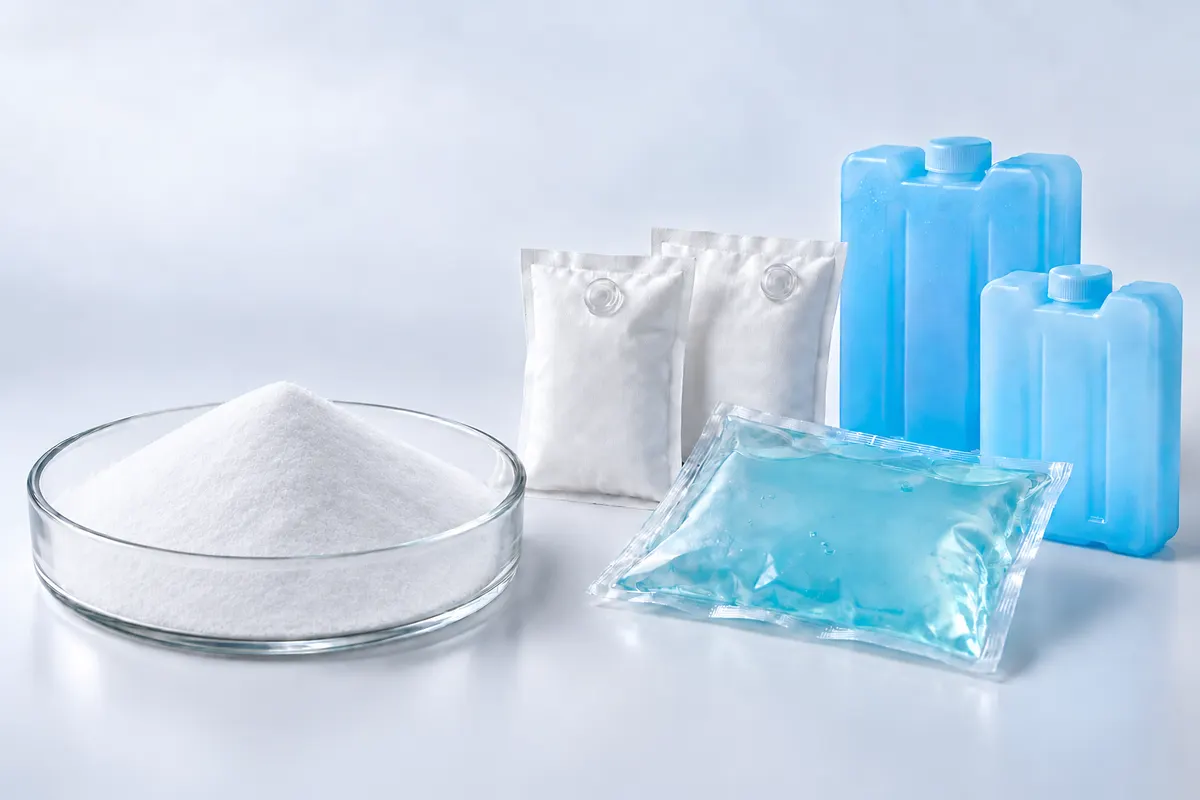
Water alone makes a poor cold pack. It freezes into a hard block and floods out if the film is punctured. Gelling it with a small amount of superabsorbent keeps the water evenly spread across the pack, holds it in place if the film is damaged and helps the pack stay flexible enough to sit against a product or a person.
Cold-chain packs for food and pharmaceutical shipping, first-aid and sports packs, and reusable lunch-box packs all use the same principle, but each needs a slightly different texture, from a firm block-like gel to a soft, flowing one.
Some lines pre-mix polymer and water into a gel, then pump the gel into the film before sealing. Gel viscosity and pumping behaviour matter here, and a gel that is too firm is hard to dose accurately.
Other lines drop dry polymer into the pouch, often with a nonwoven insert, and add the water afterwards, or ship the pack dry for the user to soak. Particle size and dust control matter more for this route, and the polymer has to hydrate evenly without clumping inside a sealed pouch.
When dry polymer meets water, the outside of each granule swells first. Fine particles hydrate quickly but can stick together into lumps with a dry core, often called fish eyes. Coarser particles disperse more easily but take longer to swell. Grade selection balances that trade-off against the speed of the filling line.
Gel strength decides how the pack feels and how it behaves over freeze-thaw cycles. A weak gel can weep free water after repeated cycles, while a very strong one can feel lumpy. Water quality matters too: hard water and added salts or preservatives reduce swelling and change texture.
These are potential operational benefits subject to material testing and field or production validation.
Even gel through the pack without hard or watery spots
Less leakage if the film is punctured in use
Grade choice matched to wet-fill or dry-dose lines
Consistent batches once water, grade and dosing are controlled
Screening compares candidate grades in your formulation for time to full gel, lumping, texture and flow, and gives a starting concentration for production trials. AuraSorb is stocked in Melbourne and supplied in 15 kg pails, 20 kg and 25 kg bags, and 750 kg and 800 kg bulk bags, depending on the grade. Finished-pack performance is validated by the manufacturer in its own packaging.
Fine polymer particles that touch water together swell on the outside and trap dry powder inside. Better dispersion, a coarser grade or adding powder to moving water usually helps.
Ice crystals can push water out of a weak gel. A higher concentration or a grade with more gel strength can reduce weeping, which is checked in freeze-thaw testing.
Yes. Calcium and magnesium in hard water reduce swelling and change texture, so screening uses the water the plant will actually use.
No. AuraChem supplies the polymer and supports grade selection. The pack manufacturer validates the finished pack for its intended use.

A potassium-based polymer that stores water in a gel, as an ice pack does, but in potting mix and soil.
Relevant Products

Turns aqueous liquid into a firm gel inside a closed container, using closely related chemistry.
Relevant Products
Tell us your pack format and filling method and we will compare AuraSorb 4000 grades in your own formulation water.